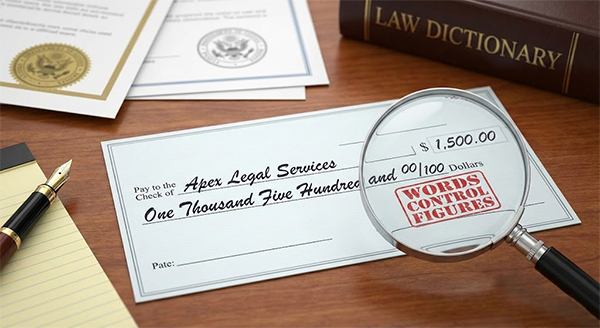
In the world of finance and law, a simple typo isn’t just a mistake—it’s a potential legal liability. If you’ve ever wondered why we still have to write out “One Thousand Two Hundred” on a check when the box already says “$1,200,” the answer lies in a centuries-old legal principle.
Understanding how to properly write numbers in words is essential for anyone handling checks, contracts, or promissory notes. This guide explains the standards that keep your transactions secure and legally binding.
1. The Golden Rule: Words Control Figures
Most global banking laws (including the Uniform Commercial Code in the US) follow a specific hierarchy of truth: Words control figures.
If a check has two different amounts—for example, the numerical box says $1,050 but the written line says “One hundred fifty dollars”—the bank is legally required to honor the written words ($150).
Why does this rule exist? It is much easier to accidentally slip a pen and add an extra “0” to a number than it is to accidentally write out the wrong words. The words are considered a more “deliberate” expression of your intent.
2. How to Format Amounts for Maximum Security
To prevent fraud and ensure bank acceptance, follow these professional standards for the “Legal Line” of your check:
Start at the Far Left
Never leave a gap at the beginning of the line. If you leave space, a fraudster could “prefix” your amount. For example, they could turn “Fifty Dollars” into “Nine hundred Fifty Dollars.”
Use the Fractional Cent Standard
In professional accounting, we don’t write “fifty cents.” Instead, we use a fraction over 100. This makes it impossible to alter the decimal value.
- Correct: One Hundred Twenty-Five and 50/100
- Incorrect: One Hundred Twenty-Five point five
The “And” Rule
In American banking, the word “and” should only be used to separate dollars from cents (the decimal point).
- Standard: “Two Hundred Fifty-Five and 10/100.”
- Avoid: “Two Hundred and Fifty-Five…” (This can cause confusion about where the decimal begins).
3. Avoiding Fraud: The “Fill the Line” Strategy
Once you have written the amount, there is often empty space left on the line. Always draw a thick line from the end of your words to the printed word “Dollars.” This prevents anyone from adding extra words at the end of your amount.
4. Comparison: Casual vs. Legal Writing
| Context | Casual Writing | Legal/Financial Writing |
| Hyphenation | Often ignored | Mandatory for 21 through 99 |
| Decimal | “point five” | “and 50/100” |
| Large Numbers | 1 Million | One Million and 00/100 |
| Ending | Ends abruptly | Use a line or the word “Only” |
5. Why Precision Matters
A bank has the right to refuse a check that is “ambiguous.” If your handwriting is messy or your spelling is incorrect, your payment could be delayed, leading to late fees or a damaged reputation with a vendor.
Using a dedicated Number to Words converter ensures that your spelling, hyphenation, and “And” placement are perfectly aligned with banking standards. It removes the human error from the most critical part of your financial documents.